The Mid Suburban League acquitted itself well at the IHSA State Tournament this weekend led by a resurgent Barrington team. After a disappointing 3-5, regular season, Barrington went 5-2 to finish 14th in the state led by 3rd Board Vyas Alwar who went 5.5-1.5 to earn the 10th place medal for that board. Also finishing with five points were Prospect at 16th, Buffalo Grove at 18th, and Fremd at 23rd. Close behind was Rolling Meadows at 29th with 4.5-2.5. Hoffman Estates finished 45th with 4-3. Conant and Palatine went 4-3 to finish 83rd and 85th and Schaumburg scored 2.5-4.5.
Placing five teams in the top thirty was the best that the MSL has ever achieved, but the real highlight was Prospect's Robert Moskwa and Buffalo Grove's Matt Wilber taking the 1st and 2nd medals on 1st Board with perfect 7-0 scores. Robert got the nod on tie-breaks because his opponents scored a combined 27-22 in the tournament while Matt's went 24-25. Robert also learned that he has been invited to the Denker Qualifying Tournament at the end of March where he will play in a round robin against Sam Schmakel, Adarsh Jayakumar, Aakash Meduri, and Kent Cen.
Showing posts with label Conant. Show all posts
Showing posts with label Conant. Show all posts
Sunday, February 12, 2012

Wednesday, October 5, 2011
Endgames: Position Pieces Prior to Pushing Pawns
The most common mistake I see players on the lower boards make in the endgames is pushing pawns before their pieces are in a position to support the advance. Sometimes the game does come down to a race between unobstructed pawns, but I think it is much more common that a pawn will need support to advance. A player should always ask himself whether he needs to improve the position of his pieces before pushing a passed pawn.

This position occurred on 5th Board in the Conant match. White has an extra passed a-pawn, but all three of Black's pieces are well positioned to oppose its advance. The only piece supporting the pawn is the White rook, but since it is front of the pawn, it will have to move off the a-file in order for the pawn to reach the queening square at which point the pawn will be completely unprotected. Since the a-pawn is perfectly secure on its present square, White's first priority should be to get his king and knight involved in the game. Bringing the knight to c4 via e3 is one obvious plan.

The game eventually reached a king and pawn ending. The winning technique here is for White to get his king in front of his pawn with 57.Kg5 Kf7 58.Kh6 Kg8 59.Kg6 Kh8 60.g5 Kg8 61.Kh6 Kh8 62.g6 Kg8 63.g7 Kf7 64.Kh7 and the pawn queens. After 57.g5, which White played, Black should have been able to draw with 57...Kf7 58.Kh5 Kg7 59.g6 as long as he remembered that Straight Back Draws 59...Kg8 60.Kh6 Kh8 61.g7+ Kg8 62.Kg6 stalemate.

This endgame occurred on 6th Board against Conant. It should be a fairly easy win for Black. In an open position with pawns on both sides of the board, the rook is a much stronger piece than the knight. All Black needs to do is to find a square for the rook that maximizes its attacking capabilities. Any square on the 2nd rank would give the rook many targets. 26...Re1 is a logical way to start.

Unfortunately, Black chose to advance pawns instead. Rooks are much better at attacking than defending. Even after several pawn moves, Black still could have gone on the offensive with 32...Rd2.
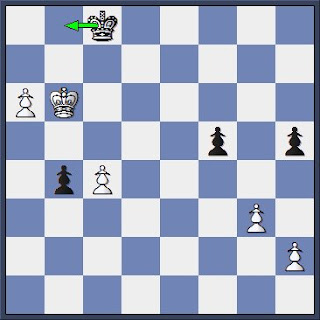
In this final position, the Black pawn doesn't need any support, but Black still needs to improve his piece before pushing it. In the game, Black played 50...b3? and lost after 51.a7 b2 52.a8=Q+ Ke7 53.Qa2. Black could have won with 50...Kb8! 51.a7+ Ka8 52.c5 b3 53.c6 b2 57.c7 b1=Q+.

This position occurred on 5th Board in the Conant match. White has an extra passed a-pawn, but all three of Black's pieces are well positioned to oppose its advance. The only piece supporting the pawn is the White rook, but since it is front of the pawn, it will have to move off the a-file in order for the pawn to reach the queening square at which point the pawn will be completely unprotected. Since the a-pawn is perfectly secure on its present square, White's first priority should be to get his king and knight involved in the game. Bringing the knight to c4 via e3 is one obvious plan.

The game eventually reached a king and pawn ending. The winning technique here is for White to get his king in front of his pawn with 57.Kg5 Kf7 58.Kh6 Kg8 59.Kg6 Kh8 60.g5 Kg8 61.Kh6 Kh8 62.g6 Kg8 63.g7 Kf7 64.Kh7 and the pawn queens. After 57.g5, which White played, Black should have been able to draw with 57...Kf7 58.Kh5 Kg7 59.g6 as long as he remembered that Straight Back Draws 59...Kg8 60.Kh6 Kh8 61.g7+ Kg8 62.Kg6 stalemate.

This endgame occurred on 6th Board against Conant. It should be a fairly easy win for Black. In an open position with pawns on both sides of the board, the rook is a much stronger piece than the knight. All Black needs to do is to find a square for the rook that maximizes its attacking capabilities. Any square on the 2nd rank would give the rook many targets. 26...Re1 is a logical way to start.

Unfortunately, Black chose to advance pawns instead. Rooks are much better at attacking than defending. Even after several pawn moves, Black still could have gone on the offensive with 32...Rd2.

In this final position, the Black pawn doesn't need any support, but Black still needs to improve his piece before pushing it. In the game, Black played 50...b3? and lost after 51.a7 b2 52.a8=Q+ Ke7 53.Qa2. Black could have won with 50...Kb8! 51.a7+ Ka8 52.c5 b3 53.c6 b2 57.c7 b1=Q+.
Friday, September 30, 2011
Prospect v. Conant: Putting the Horse in the Corral
The third veteran to come through in the Conant match was sophomore Mike Monsen on 2nd Board. Although tactically a little rusty from the summer layoff, Mike played a very solid game positionally. The ending from the game provides a good example of the way that a bishop can dominate a knight in an ending.

While watching the game, I liked the idea of taking the c1 square away from the Black knight with 41.Be3 when Black will be forced to give up a pawn to extract his knight with either 41...c5 42.Kc3 Na5 43.Bxc5 or 41...b5 42.cxb5 cxb5 43.Kc3 Na5 44.Kb4 Nc4 45.Bd4 Nd6 46.Kc5 Nb7+ 47.Kxb5. The knight would be trapped after 41...Na5 42.b4 Nb3 43.Kc3 Na1 44.Kb2.
The computer indicates that 41. Kc2! is an even stronger way to confine the knight. 41...Na5 42.c5 Nc4 43.Bd4.

The only way Black can save the knight is by giving up the b-pawn. 43...b5 44.cxb6 (Don't forget en passant!) Nd6. 41.Be3 merely wins a second pawn. 41.Kc2! wins a second pawn on the 6th rank.
In the game Mike played 41.Kc3 and the Black knight managed to slip away to a secure spot via c1-e2-f4. Happily, Mike's technique was more than sufficient to win with only one extra pawn.

While watching the game, I liked the idea of taking the c1 square away from the Black knight with 41.Be3 when Black will be forced to give up a pawn to extract his knight with either 41...c5 42.Kc3 Na5 43.Bxc5 or 41...b5 42.cxb5 cxb5 43.Kc3 Na5 44.Kb4 Nc4 45.Bd4 Nd6 46.Kc5 Nb7+ 47.Kxb5. The knight would be trapped after 41...Na5 42.b4 Nb3 43.Kc3 Na1 44.Kb2.
The computer indicates that 41. Kc2! is an even stronger way to confine the knight. 41...Na5 42.c5 Nc4 43.Bd4.

The only way Black can save the knight is by giving up the b-pawn. 43...b5 44.cxb6 (Don't forget en passant!) Nd6. 41.Be3 merely wins a second pawn. 41.Kc2! wins a second pawn on the 6th rank.
In the game Mike played 41.Kc3 and the Black knight managed to slip away to a secure spot via c1-e2-f4. Happily, Mike's technique was more than sufficient to win with only one extra pawn.
Wednesday, September 28, 2011
Prospect v. Conant: The Veterans Come Through
Here are a couple more games from the Prospect-Conant match. On 1st Board, Caleb Royse won a piece in the opening and kept a tight grip on the position throughout the entire game. His opponent really never had any counterplay. On 3rd Board, Ekrem Genc built a very solid position out of the opening but blundered away a knight on the 19th move. However, because Echo had a good position before the error, it was not easy for his opponent to consolidate his advantage. When he failed to find the best move, Echo quickly took advantage.
Prospect v. Conant: Fast Freshmen Face First Foes
Prospect opened the 2011-2012 season with a 41-27 victory at Conant. With Robert Moskwa unavailable, Caleb Royse played 1st Board for the first time and Mike Monsen and Ekrem Genc moved up three boards from last year to 2nd and 3rd. On 4th through 6th Boards, Prospect fielded freshmen Kyle Gilligan, Marc Graff, and Alexander Johnson. While a junior, Giovani Roldan was also new to chess club and playing in his first match. Prospect started 5 points in the hole when it forfeited 8th Board and faced a 27-0 deficit after three of its newcomers lost quickly. However, Mark Graff managed a win on 5th Board and the three returning players all won their games to give Prospect the win.
Freshman Futility.
I well remember my first visit to the high school chess club as a freshman exactly thirty years ago. I had learned the game at home and I held my own pretty well against my older brothers so I was optimistic about my chances. That didn't last very long. I was slaughtered in game after game. After a few visits, I gave up on chess and didn't return for the rest of the year.
During the summer between my freshman and sophomore years, Bobby Fischer played Boris Spassky for the World Chess Championship and for a brief shining moment, chess was cool in the United States. A good friend of mine became interested in the match and we played through the game scores that appeared in the newspaper. We also watched some of the games on public television where a master would analyze the games.
While most of the analysis was way over my head, it was clear to me that real chess players thought through their moves in ways that had never occurred to me. They did not play the first move that came into their heads and hope that something good would happen. They considered all their possible moves and spent time trying to figure out how their opponent might reply to each one. Real chess players played real chess.
When school started again, my friend and I both joined the chess club and we managed to move up to 3rd and 4th Boards by the end of the year.
The Newcomers at Conant
The performance of Prospect's newcomers was pretty typical for players in their first match.
(1) They played much too quickly. All of them had made twenty moves before five minutes were gone from their clock. Often they took no more than a few seconds to think about their moves.
(2) They did not think about what their opponent was threatening.
(3) They played the first move that occurred to them without thinking about alternatives.
(4) They did not try to figure out how their opponent was likely to respond to the move they were considering.
Here are a couple examples of what I'm talking about from the game on 5th Board between Marc Graff and Ming Tsai:

The game began 1.e4 d5.
Question: What is Black threatening?
Answer: 2...dxe4 winning a pawn.
Question: How can White deal with that threat?
Answer #1: Capture the attacking pawn with 2.exd5. This is considered best.
Answer #2: Move the pawn that is being attacked with 2.e5. This is reasonable.
Answer #3: Protect the pawn that is being attacked with 2.d3 or 2.Nc3. These are rather passive.
What White actually played was 2.Nf3? which just loses a pawn.
Question: Why did White play this move?
Answer: Although I don't know for sure, my guess would be that he made his move automatically without thinking about what his opponent had done. He might have expected his opponent to play 1...e5 which is much more common than 1...d5. After 1...e5, the best move is 2.Nf3. 2.Nf3 is also the best move against 1...c5. 2.Nf3 is also a perfectly playable move against 1...e6, 1...c6 and 1...d6, and 1...Nc6. 2.Nf3 is only bad if Black plays 1...d5 or 1...Nf6 because those moves threaten the White pawn on e4.
(I will confess that I have played 2.Nf3? in the same situation, however, I did it in a one-minute blitz game on the internet.)

Question: What is Black threatening?
Answer: 17...Nex4 winning the e-pawn.
Question: How can White deal with that threat?
Answer #1: Capture the attacking piece with 17.Qxc5?? This is terrible due to 17...Qxc5.
Answer #2: Protect the pawn that is being attacked with 17.f3.
Answer #3: Force Black to deal with a more serious threat by attacking the Black queen with either 17. Nf5 or 17.Rd1, which is what White played in the game, which was followed by 17...Nxe4 18.Rxd6 Nxc3 19.Rxc6.
Question: Which is stronger, 17.Nf5 or 17.Rd1?
Answer: 17.Nf5. If Black plays 17...Nxe4??, White plays 18.Nxd6+! After 18...exd6, White moves his queen to safety. Black must move his queen an the knight on c5 will be unprotected, e.g., 17...Qe6 18.Qxc5.
Question: Why did White play 17.Rd1?
Answer: I don't know for sure, but my guess would be that he saw that move first and did not take the time to think about other possibilities. To be clear, 17.Rd1 was not a bad move, however, there was a much better move available and White had plenty of time to evaluate alternatives.
Casual Chess vs. Serious Chess.
Chess can be a very unforgiving game. If you make a mistake in a tennis match, you can forget about it and move on to the next point. If you make a mistake in chess, however, you are stuck with the consequences for the rest of the game. Lose a piece and you may never have the chance to get it back. Allow a back rank mate and the game is over.
In serious chess, you have to think on every move. You have to look for your opponents threats. You have to consider your alternatives. Most importantly, you have to think about your opponent's best response to the move you are thinking about playing.
The good news is that every time you put in the effort, your understanding of the game will increase. Patterns and tactics will become familiar to you. You will learn to spot your opponents threats and anticipate responses to your moves more quickly.
Freshman Futility.
I well remember my first visit to the high school chess club as a freshman exactly thirty years ago. I had learned the game at home and I held my own pretty well against my older brothers so I was optimistic about my chances. That didn't last very long. I was slaughtered in game after game. After a few visits, I gave up on chess and didn't return for the rest of the year.
During the summer between my freshman and sophomore years, Bobby Fischer played Boris Spassky for the World Chess Championship and for a brief shining moment, chess was cool in the United States. A good friend of mine became interested in the match and we played through the game scores that appeared in the newspaper. We also watched some of the games on public television where a master would analyze the games.
While most of the analysis was way over my head, it was clear to me that real chess players thought through their moves in ways that had never occurred to me. They did not play the first move that came into their heads and hope that something good would happen. They considered all their possible moves and spent time trying to figure out how their opponent might reply to each one. Real chess players played real chess.
When school started again, my friend and I both joined the chess club and we managed to move up to 3rd and 4th Boards by the end of the year.
The Newcomers at Conant
The performance of Prospect's newcomers was pretty typical for players in their first match.
(1) They played much too quickly. All of them had made twenty moves before five minutes were gone from their clock. Often they took no more than a few seconds to think about their moves.
(2) They did not think about what their opponent was threatening.
(3) They played the first move that occurred to them without thinking about alternatives.
(4) They did not try to figure out how their opponent was likely to respond to the move they were considering.
Here are a couple examples of what I'm talking about from the game on 5th Board between Marc Graff and Ming Tsai:

The game began 1.e4 d5.
Question: What is Black threatening?
Answer: 2...dxe4 winning a pawn.
Question: How can White deal with that threat?
Answer #1: Capture the attacking pawn with 2.exd5. This is considered best.
Answer #2: Move the pawn that is being attacked with 2.e5. This is reasonable.
Answer #3: Protect the pawn that is being attacked with 2.d3 or 2.Nc3. These are rather passive.
What White actually played was 2.Nf3? which just loses a pawn.
Question: Why did White play this move?
Answer: Although I don't know for sure, my guess would be that he made his move automatically without thinking about what his opponent had done. He might have expected his opponent to play 1...e5 which is much more common than 1...d5. After 1...e5, the best move is 2.Nf3. 2.Nf3 is also the best move against 1...c5. 2.Nf3 is also a perfectly playable move against 1...e6, 1...c6 and 1...d6, and 1...Nc6. 2.Nf3 is only bad if Black plays 1...d5 or 1...Nf6 because those moves threaten the White pawn on e4.
(I will confess that I have played 2.Nf3? in the same situation, however, I did it in a one-minute blitz game on the internet.)

Question: What is Black threatening?
Answer: 17...Nex4 winning the e-pawn.
Question: How can White deal with that threat?
Answer #1: Capture the attacking piece with 17.Qxc5?? This is terrible due to 17...Qxc5.
Answer #2: Protect the pawn that is being attacked with 17.f3.
Answer #3: Force Black to deal with a more serious threat by attacking the Black queen with either 17. Nf5 or 17.Rd1, which is what White played in the game, which was followed by 17...Nxe4 18.Rxd6 Nxc3 19.Rxc6.
Question: Which is stronger, 17.Nf5 or 17.Rd1?
Answer: 17.Nf5. If Black plays 17...Nxe4??, White plays 18.Nxd6+! After 18...exd6, White moves his queen to safety. Black must move his queen an the knight on c5 will be unprotected, e.g., 17...Qe6 18.Qxc5.
Question: Why did White play 17.Rd1?
Answer: I don't know for sure, but my guess would be that he saw that move first and did not take the time to think about other possibilities. To be clear, 17.Rd1 was not a bad move, however, there was a much better move available and White had plenty of time to evaluate alternatives.
Casual Chess vs. Serious Chess.
Chess can be a very unforgiving game. If you make a mistake in a tennis match, you can forget about it and move on to the next point. If you make a mistake in chess, however, you are stuck with the consequences for the rest of the game. Lose a piece and you may never have the chance to get it back. Allow a back rank mate and the game is over.
In serious chess, you have to think on every move. You have to look for your opponents threats. You have to consider your alternatives. Most importantly, you have to think about your opponent's best response to the move you are thinking about playing.
The good news is that every time you put in the effort, your understanding of the game will increase. Patterns and tactics will become familiar to you. You will learn to spot your opponents threats and anticipate responses to your moves more quickly.
Wednesday, November 10, 2010
The Queen and Pawn Ending
Which player has the better chances in the following position?
 While having an extra pawn is usually preferable, when the only pieces on the board are the queens, a single pawn that is far advanced can be worth more than several pawns that are not if the advanced pawn cannot be blockaded by the opponent's king. In Patel v. Monsen, the players agreed to a draw after 44...Qg7 45.Qf4+. While a draw was not an unreasonable result, had the match still been in doubt, it would have been reasonable for Black to have played for a win.
The problem for White is that the only way to stop the Black pawn from advancing is by keeping the Black king in check. As a result, he does not have the time he needs to advance his own pawns. The problem for Black is that his king is in the of a wide open board and White has lots and lots of checking opportunities. Nevertheless, White has to careful not to deliver a check that can be blocked with a counter-check or with a pin that will force the exchange of queens. For example, after 44...Ke7, 45.Qe4+ would be met with 45...Qe6 forcing the queens of the board. Black may be able to use this possibility to leave White without a good check for a move or two which is all Black needs to advance the pawn.
One possibility after 44...Ke7 is 45.Qg5+ Qf6 46.Qc5+ Qd6 47.Qg5+ Kf7 48.Qf5+ Qf6 49. Qh7+ Qf8.
 White now has no checks and he must try to prevent the pawn from advancing with 50. Qb1. Black then can prepare the advance with 50...Qf7 when Black can force the queens off the board after either 51.Qc8+ Qe8+ or 51. Qc5+ Qe7+. After 51.Kd2 a2 52.Qa1 Qf2+ 53.Kd3 Qxh2, Black has reestablished material equality, but he is going to be subjected to another avalanche of checks. Whether Black can actually force the pawn home is far from clear, nevertheless, there will be plenty of chances for White to go wrong and the winning chances definitely lie with Black.

Two things to remember in endings with queens and pawns on both sides:
(1) Having the most pawns is not as important as having the most advanced pawn.
(2) Even though the board looks wide open, don't assume that perpetual check is inevitable. It is often possible to leave your opponent without any good checks.
While having an extra pawn is usually preferable, when the only pieces on the board are the queens, a single pawn that is far advanced can be worth more than several pawns that are not if the advanced pawn cannot be blockaded by the opponent's king. In Patel v. Monsen, the players agreed to a draw after 44...Qg7 45.Qf4+. While a draw was not an unreasonable result, had the match still been in doubt, it would have been reasonable for Black to have played for a win.The problem for White is that the only way to stop the Black pawn from advancing is by keeping the Black king in check. As a result, he does not have the time he needs to advance his own pawns. The problem for Black is that his king is in the of a wide open board and White has lots and lots of checking opportunities. Nevertheless, White has to careful not to deliver a check that can be blocked with a counter-check or with a pin that will force the exchange of queens. For example, after 44...Ke7, 45.Qe4+ would be met with 45...Qe6 forcing the queens of the board. Black may be able to use this possibility to leave White without a good check for a move or two which is all Black needs to advance the pawn.
One possibility after 44...Ke7 is 45.Qg5+ Qf6 46.Qc5+ Qd6 47.Qg5+ Kf7 48.Qf5+ Qf6 49. Qh7+ Qf8.
 White now has no checks and he must try to prevent the pawn from advancing with 50. Qb1. Black then can prepare the advance with 50...Qf7 when Black can force the queens off the board after either 51.Qc8+ Qe8+ or 51. Qc5+ Qe7+. After 51.Kd2 a2 52.Qa1 Qf2+ 53.Kd3 Qxh2, Black has reestablished material equality, but he is going to be subjected to another avalanche of checks. Whether Black can actually force the pawn home is far from clear, nevertheless, there will be plenty of chances for White to go wrong and the winning chances definitely lie with Black.
Two things to remember in endings with queens and pawns on both sides:
(1) Having the most pawns is not as important as having the most advanced pawn.
(2) Even though the board looks wide open, don't assume that perpetual check is inevitable. It is often possible to leave your opponent without any good checks.
Prospect moves to 4-1
Losing 49-19, Prospect discovered last week that even with the graduation of expert Zach Kasiurak, Barrington is not a team to be taken lightly. However, it rebounded yesterday with a 53-15 win over Conant. Next week brings the groves of the buffalo and elk.
Thursday, October 29, 2009
Prospect v. Conant: To Thine Own Self Be True
Prospect beat Conant 51-17 with Conant winning on 1st and 8th boards and Prospect capturing all the middle boards.
Yoon v. Zwolenik 1st Board
In working with high school players, I have noticed that they are not always the best judges of what types of positions they handle well. For example, I have known players who would choose openings that tend to lead to sharp attacking positions, however, at the crucial moment when it came time to throw caution to the winds and break open the position, they instinctively sought a sedate move. I think that such a disconnect between preferences and instincts was at work on 1st Board.
Playing the Black pieces, Prospect's Mike Zwolenik allowed Conant's Jiwon Yoon to play the legendary "Fried Liver Attack" (Yes, that's really what it's called) in which White sacrifices a knight in order to force the Black king out into the center of the board where it is subject to a withering attack. If Black survives the attack, he has an extra knight and an easily won endgame. That's a very big if though. It is not a position that I would have any desire to play as Black, but Mike has told me that he likes it. The board looked like this after White's tenth move.
 Mike has two choices: (1) Grab the White rook with 10...Nxa1 whereupon White will capture the knight on d5 leaving the Black king all alone in the middle of the board with only the e-pawn to hide behind; or (2) shore up the center with 10...c6 allowing Black to capture the knight on c2. He chose to shore up his center. Discussing the position out in the hall with Prospect coach Don Barrett, I sympathized with Mike's reluctance to part with his only centralized piece while he believed that giving up the knight to pick up the rook was worth the risk. As I look at the game more closely however, I am persuaded that Mr. Barrett was correct. I think that Black could have survived White's attack and that the extra material would have paid off in the long run.
I certainly cannot fault Mike's choice on a practical level as the position is very complicated and he had to rely on instinct to some extent because there isn't enough time to calculate out all the possibilities. On the other hand a person who "likes" to play the Black side of the Fried Liver should be a person who is willing to take his chances on his king's ability to survive a drafty without its death of cold in order to gain a material advantage. The fact that Mike wasn't inclined to do so suggests to me that he might not be as comfortable with a variation like this as he thinks he is.
As it turned out White still had a very nasty attack and Mike found several very accurate moves to stay in the game although he eventually succumbed to the pressure. Even if he had survived the attack though, material would have been even and a draw might have been the result. On the other hand, if he had survived the attack after grabbing the rook, he would have had enough extra material to win.
Meyers v. Itskovich
The game on 5th Board between Prospect's Pat Meyers and Conant's Peter Itskovich provided an interesting contrast between a player who disregarded opening principles and one who adhered to those same principles a little too dogmatically. "Don't make too many pawn moves," "Don't bring out the queen early," and "Develop knights before bishops," are all useful principles, however, all opening principles implicitly include the caveat "without a good reason." The most common good reason is to either win material or prevent the loss of material, but acquiring dominant control of the center and a substantial advantage in space can be good reasons, too.
 Openings like this are not all that uncommon on the lower boards of high school matches. The failure to fight for the center may make serious players cringe, but it does not lose automatically. Moreover, just because Black ignores accepted opening theory doesn't mean that he doesn't have some tactical skills that may make White's life miserable if he doesn't take the position seriously. As the game turned out, White did was not as aggressive as he might have been and Black came out of the opening with a tenable position. However, when Black cooperated in opening the position, White was able to take advantage
Yoon v. Zwolenik 1st Board
In working with high school players, I have noticed that they are not always the best judges of what types of positions they handle well. For example, I have known players who would choose openings that tend to lead to sharp attacking positions, however, at the crucial moment when it came time to throw caution to the winds and break open the position, they instinctively sought a sedate move. I think that such a disconnect between preferences and instincts was at work on 1st Board.
Playing the Black pieces, Prospect's Mike Zwolenik allowed Conant's Jiwon Yoon to play the legendary "Fried Liver Attack" (Yes, that's really what it's called) in which White sacrifices a knight in order to force the Black king out into the center of the board where it is subject to a withering attack. If Black survives the attack, he has an extra knight and an easily won endgame. That's a very big if though. It is not a position that I would have any desire to play as Black, but Mike has told me that he likes it. The board looked like this after White's tenth move.
 Mike has two choices: (1) Grab the White rook with 10...Nxa1 whereupon White will capture the knight on d5 leaving the Black king all alone in the middle of the board with only the e-pawn to hide behind; or (2) shore up the center with 10...c6 allowing Black to capture the knight on c2. He chose to shore up his center. Discussing the position out in the hall with Prospect coach Don Barrett, I sympathized with Mike's reluctance to part with his only centralized piece while he believed that giving up the knight to pick up the rook was worth the risk. As I look at the game more closely however, I am persuaded that Mr. Barrett was correct. I think that Black could have survived White's attack and that the extra material would have paid off in the long run.
I certainly cannot fault Mike's choice on a practical level as the position is very complicated and he had to rely on instinct to some extent because there isn't enough time to calculate out all the possibilities. On the other hand a person who "likes" to play the Black side of the Fried Liver should be a person who is willing to take his chances on his king's ability to survive a drafty without its death of cold in order to gain a material advantage. The fact that Mike wasn't inclined to do so suggests to me that he might not be as comfortable with a variation like this as he thinks he is.
As it turned out White still had a very nasty attack and Mike found several very accurate moves to stay in the game although he eventually succumbed to the pressure. Even if he had survived the attack though, material would have been even and a draw might have been the result. On the other hand, if he had survived the attack after grabbing the rook, he would have had enough extra material to win.
Meyers v. Itskovich
The game on 5th Board between Prospect's Pat Meyers and Conant's Peter Itskovich provided an interesting contrast between a player who disregarded opening principles and one who adhered to those same principles a little too dogmatically. "Don't make too many pawn moves," "Don't bring out the queen early," and "Develop knights before bishops," are all useful principles, however, all opening principles implicitly include the caveat "without a good reason." The most common good reason is to either win material or prevent the loss of material, but acquiring dominant control of the center and a substantial advantage in space can be good reasons, too.
 Openings like this are not all that uncommon on the lower boards of high school matches. The failure to fight for the center may make serious players cringe, but it does not lose automatically. Moreover, just because Black ignores accepted opening theory doesn't mean that he doesn't have some tactical skills that may make White's life miserable if he doesn't take the position seriously. As the game turned out, White did was not as aggressive as he might have been and Black came out of the opening with a tenable position. However, when Black cooperated in opening the position, White was able to take advantage
Subscribe to:
Posts (Atom)
